
By Emery Lewis and Amelia Hogge, Opinion and Managing Editors
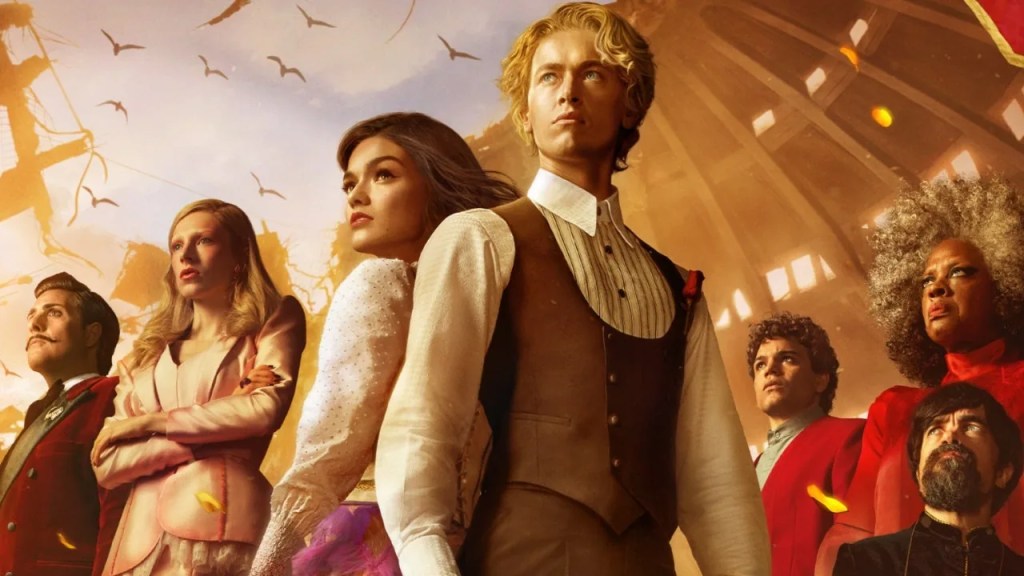
Already having made over $200 million worldwide, The Ballad of Songbirds and Snakes is quickly moving up in the ranks of the most popular movies of the year. This highly anticipated prequel to the iconic Hunger Games series came to theaters on Nov. 17 and made $44 million the first weekend of its release.
The Ballad of Songbirds and Snakes explores the early life of the future President of Panem, Coriolanus Snow, and how he came to be the tyrannical ruler he was. Although there were most likely many factors leading him down the path of evil, what is shown the most in The Ballad of Songbirds and Snakes was his insatiable love of power, and how that led him to destroy any good thing he had just to achieve that power.
The Hunger Games takes place around 300 years in the future in Panem, which was previously known as North America. Panem is run by the extremely wealthy Capitol which oversees the 13 Districts. Each District specializes in one way to provide for the Capitol; for example district four is fishing, district seven is lumber, and district twelve coal. The Capitol dictates all of Panem, and the President of Panem is in control of all the people of the districts and the Capitol. Each district holds a different level of wealth, with District one being the wealthiest and District 13 being the poorest.
District 13 started an uprising against the Capitol and their oppressive rule. This led to a civil war that lasted 3 years and ended in the Capitol’s victory.
The Hunger Games began after the war ended as punishment to the districts. Each year, two tributes from each district, one male and one female, would be chosen to participate in a fight to the death, with only one tribute being claimed the victor in the end.
Staring Tom Blyth as the infamous President Corioanus Snow, The Ballad of Songbirds and Snakes followed Snow’s early years as a student at the The Academy in the Capitol, where he is assigned, along with his other classmates, to be the first mentors of the tributes for the 10th Annual Hunger Games. Snow is assigned Lucy Gray Baird, played by Rachel Zegler, the female tribute from District 12, who shows great talent for singing and dancing.
Martha Zamarr (‘26) explained how much she loved everything about the movie, especially the musical component Lucy Gray introduced.
“I really loved the music. I thought it was such a good touch. I also really loved Lucy’s character. And I loved all the parallels between her and Katniss.”
As the capitol prepares for the games, Snow makes an effort to use Lucy Gray’s charm to garner sympathy from capitol spectators. He brings food to her while she is kept locked up and starved in the capitol zoo, and the rest of the mentors follow suit. Snow also comes up with a sponsor system, where the people of the capitol can send money to the mentors of their favorite tributes and their mentors can send their tributes food and water in the games.
In the games, the tributes fall one by one, while Lucy Gray hides with her fellow male tribute from district 12 in tunnels beneath the arena. Snow helps her multiple times during the games, knowingly defying the rules to save her, and she eventually wins after the capitol releases deadly snakes into the arena, which kill all the remaining tributes except Lucy Gray.
After his victory, Snow is forced to enlist as a peacekeeper in the districts as punishment for foul play. He manages to get a spot in District 12, and later meets back up with Lucy Gray. However, after a fight that ends with two District 12 citizens dead as well as Snow’s friend from the Capitol, Sejanus Plinth, Lucy Gray is forced to flee into the woods. Snow follows, believing there is evidence to condemn him to death in District 12. When Snow finds the guns tying him to murder deep in the woods, he realizes the only loose end left is Lucy Gray, who witnessed the whole thing. Lucy Gray seems to understand this, and slips away before Snow has the chance to kill her.
The movie ends with Snow back in the Capitol and one of the most powerful up-and-coming gamekeepers, heir to an enormous fortune and in line to become President of Panem.
Throughout the Hunger Games series it’s made obvious that Snow is the antagonist due to his rivalry with Katniss. However, since in the Ballad of Songbirds and Snakes where we learn his backstory and see his perspective, many fans’ views of Snow have changed. Some people say after watching or reading the Ballad of Songbirds and Snakes they feel that Snow is much worse of a person then they initially thought since they were able to not only see the way he thinks but also why he made decisions and how he treated the people he claimed to care about. Others saw the hardships he faced and gained empathy for him.
Johanna Gayoba (‘26) who is a fan of the Hunger Games and the new movie feels that her opinion on Snow did change.
“It made me see him as more human. In the trilogy he’s just this evil dictator, but in the Ballad of Songbirds and Snakes you see him as a person,” she said.
The Hunger Games series as a whole brings up many ideas about human nature, greed, power and love. All of these themes are only further explored in The Ballad of Songbirds and Snakes, while also going deeper into how President Snow came to be the evil entity he is as seen in The Hunger Games. Snow had many chances throughout his youth to be a good person. He was surrounded by empathetic and good-natured people; his cousin who he lived with, Tigris, who he abandons later in life. His supposed best friend, Sejanus, who he betrays, which causes the peacekeepers to hang him. The love of his life, Lucy Gray, who he was ready to murder in order to save himself.
Throughout the movie, so-called “acts of love” are truly only a means to Snow’s greater end. He cheats and ensures that Lucy Gray wins the game in order to receive the Plinth Prize, his only chance to regain the wealth his family lost in the war and get into the University in the Capitol. Creating the sponsor system, which may have seemed to be an act of mercy towards the starving tributes, was done in an attempt to regain his social status and prove his worthiness of the Plinth Prize. In the beginning, Snow saw Lucy Gray as only a way to achieve his dreams, and although he may have come to truly love her, he would prove throughout the movie that he loved the idea of her more than her.
Carolina Carruth (‘24), who saw the movie and read the book, explained how she believed Snow saw Lucy Gray.
“I think [Snow] loved having someone he could control- for [Lucy Gray] it was trust and for him it was power,” Carruth said.
When Snow knew he could no longer control Lucy Gray, he made the decision to kill her. This is the true turning point for Snow, where we see that, given the opportunity to leave every other evil decision he had made behind, he still chooses power and status over love.
In the Ballad of Songbirds and Snakes, Collins tells the story of how destructive the love of power can be. There is also the ever-present question of the true nature of humanity; whether humans are inherently good or evil. At the end of the movie, Snow tells the current Head Gamemaker that the games are to show Panem that the Capitol is needed to keep peace, and to prove that humans are all truly savage once stripped of safety. This directly contradicts what Lucy Gray tells him before he tries to kill her, that she believed that humans were born with a natural goodness. Although the question of good and evil is never directly answered in the movie, it reflects our own society, and brings up valid questions about how much control authority can exercise to keep peace before becoming a dictatorship.
The Ballad of Songbirds and Snakes also criticizes each person’s sense of greed, and how, even after all the opportunities we may be given to be good people, many still choose to be selfish at the expense of others.
Cover photo courtesy of IGN Nordic



 The Eagle Eye Newspaper